


The Ultimate Guide to Car Lift Safety: 10 Must-Follow Rules.

At Keystone Lifts, we believe that power and potential must always be paired with responsibility. A car lift is one of the most powerful tools in any garage, transforming how you work and store your vehicles. But with great power comes a critical need for safety. A vehicle lifted just a few feet in the air carries immense energy, and respecting that potential is non-negotiable.
Whether you’re a seasoned professional or a first-time user, following these ten fundamental safety rules is the key to preventing accidents, protecting your investment, and, most importantly, keeping yourself safe.
Rule #1: Know Your Lift’s Limits (The Golden Rule)
Every lift has a maximum weight capacity, and this is not a suggestion—it’s an absolute limit. Exceeding it is the fastest way to cause catastrophic failure.
- Action Step: Always check the data plate on the lift to confirm its rated capacity. Know the curb weight of your vehicle (including fuel, fluids, and any cargo) and ensure it is well under the lift’s limit. Remember, a “5-ton lift” doesn’t mean 10,000 lbs; it typically means 9,000 or 9,500 lbs. When in doubt, look it up.
Rule #2: The Pre-Lift Inspection: Never Skip It
A two-minute inspection can prevent a lifetime of regret. Make this a non-negotiable habit, every single time.
- Action Step: Before you drive on or position the arms, do a quick walk-around. Look for:
- Obstructions: Are there any tools, jack stands, or debris on the floor or runways?
- Leaks: Check for hydraulic fluid leaks on or around the lift.
- Cables & Hoses: Inspect for fraying, kinks, or damage.
- Arms and Locks: Ensure lifting arms move freely and that automatic safety locks engage with a solid “clunk” during a test cycle without a vehicle.
Rule #3: Perfect the Center of Gravity
A lift is not a seesaw. An improperly balanced vehicle can tip, with disastrous results. The vehicle’s center of gravity is the key.
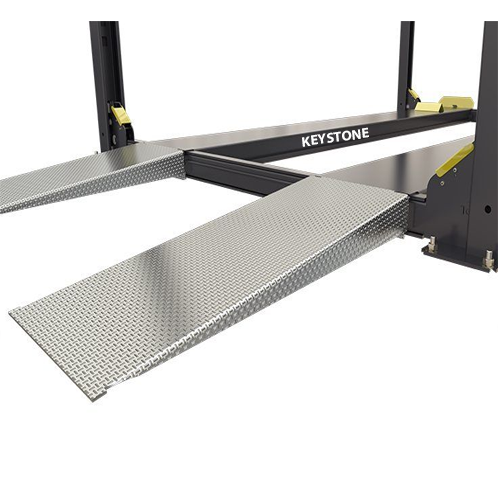
- Action Step: Consult your lift’s manual for the vehicle pickup points. On a two-post lift, the front arms should be equidistant from the front axle, and the rear arms equidistant from the rear axle. The vehicle should sit level on the lift. On a four-post lift, center the vehicle on the runways.
Rule #4: Lift Points are Sacred (Use Them!)
Your vehicle’s chassis has specific, reinforced points designed for lifting. Lifting by the rocker panels, floor pans, or differential can cause severe and expensive damage—and it’s incredibly unsafe.
- Action Step: Always refer to your vehicle’s owner’s manual to locate the official lift points. Use the correct adapters and rubber pads on your lift arms to securely contact these points. If you’re unsure, stop and find the information before proceeding.
Rule #5: The “Shake Test” is Your Best Friend
Once the vehicle is lifted just a few inches off the ground, stop. This is your final safety check.
- Action Step: Put your hands on the vehicle and gently rock it. Does it feel stable and secure? Or does it shift or feel tipsy? If anything feels wrong, lower the vehicle immediately and reposition the arms. A few seconds here can save everything.
Rule #6: Engage Mechanical Locks Before Going Under
Your lift’s hydraulic system is powerful, but it is not what keeps the vehicle in the air while you work. The mechanical locking system is.
- Action Step: As you lift, you will hear a series of loud “clicks” or “clunks” as the locks engage. Never work under a vehicle supported only by hydraulics. Always raise the vehicle until the next set of locks engages before getting underneath. When lowering, the process is the opposite: you must raise the vehicle slightly to disengage the locks before descending.
Rule #7: Keep It Clear and Clean
A cluttered workspace is a dangerous one. Tripping over a tool while under a lifted vehicle can lead to a panicked reaction and a serious incident.
- Action Step: Maintain a clean, well-lit work area. Put tools away when not in use. Ensure the floor is free of oil, grease, and other slip hazards.
Rule #8: Never, Ever Trust Just the Lift (Use Jack Stands)
For any work that involves removing major components (like suspension, transmission, or the engine) or applying significant force, the lift should not be your only safety net.
- Action Step: Place high-quality, rated jack stands under the vehicle’s frame or axle as a secondary support. This simple practice is the ultimate insurance policy against a mechanical failure.
Rule #9: Mind the Moving Parts
Be aware of your surroundings during the entire lifting and lowering process.
- Action Step: Keep hands, tools, and cords clear of moving arms and posts. Ensure no one is standing near the lift as it moves. Communicate clearly with anyone else in the shop when you are operating the lift.
Rule #10: Commit to Professional Maintenance
A car lift is a mechanical system with wear parts. Like your car, it needs regular maintenance to stay in safe working order.
- Action Step: Follow the manufacturer’s recommended maintenance schedule. This typically includes checking hydraulic fluid, lubricating moving parts, and inspecting cables and hoses. Have a certified technician perform an annual inspection to ensure all components, especially the critical safety locks, are in perfect working condition.
Safety is a Culture, Not a Checklist
Following these ten rules will make you a confident and safe lift operator. At Keystone Lifts, we engineer every one of our products with multiple layers of safety, but the most important safety feature will always be the knowledgeable and careful person at the controls.
Your passion for cars deserves a safe space to thrive. By making these rules second nature, you ensure that your garage remains a place of productivity, joy, and peace of mind for years to come.
Safety is our top priority. All Keystone Lifts are built to the highest standards and include comprehensive safety features. Have questions about maintaining your lift or proper operating procedures? Our support team is here to help. Contact us today for expert advice.
Posts Widget
-
1

-
2

-
3

-
4

We are active
Need Help?
Kindly contact our sales team.
Monday – Friday: 9:00-20:00
Saturady: 11:00 – 15:00
3 thoughts on “The Ultimate Guide to Car Lift Safety: 10 Must-Follow Rules.”
Lorem ipsum dolor sit amet, consectetur adipiscing elit, sed do eiusmod tempor incididunt ut labore et dolore magna aliqua. Quis ipsum suspendisse ultrices gravida. Risus commodo viverra maecenas accumsan lacus vel facilisis.
Lorem ipsum dolor sit amet, consectetur adipiscing elit, sed do eiusmod tempor incididunt ut labore et dolore magna aliqua. Quis ipsum suspendisse ultrices gravida. Risus commodo viverra maecenas accumsan lacus vel facilisis.
Lorem ipsum dolor sit amet, consectetur adipiscing elit, sed do eiusmod tempor incididunt ut labore et dolore magna aliqua. Quis ipsum suspendisse ultrices gravida. Risus commodo viverra maecenas accumsan lacus vel facilisis.